Mirror tint: how it looks and whether it's legal
Some films look like a mirror from outside and hide the cabin completely. Here is how they work, what they actually look like, and what to check before booking.
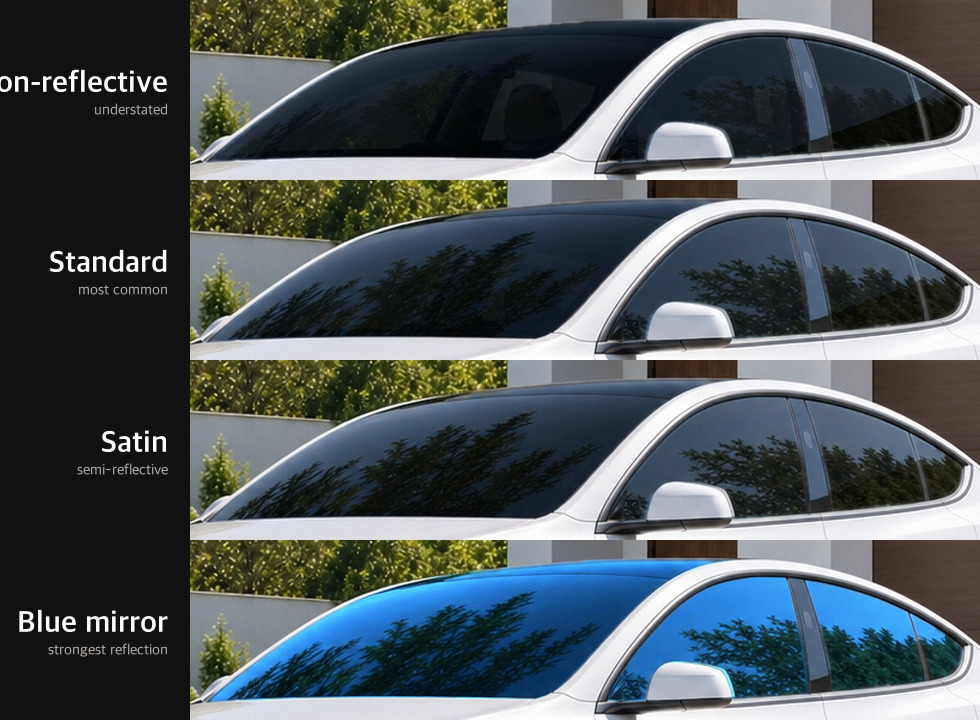
What makes it mirror
A thin metal layer is sputtered onto the film. Metal reflects light, so the surroundings bounce back at the viewer and the interior disappears behind them.
This is a separate axis from shade. The same 15% reads as flat and quiet with a non-reflective film, or bright and showy as a mirror. The difference is covered in hue vs. reflectivity.
What it really looks like
| Situation | What you see |
|---|---|
| Bright day, outdoors | Close to a mirror; interior essentially hidden |
| Overcast or shaded | Reflection weakens — more shows through than expected |
| Underground parking | Little light to reflect, so the mirror effect largely disappears |
| Night with the dome light on | Interior brighter than outside — people can see in |
Mirror film is not "always opaque". Reflection happens when the outside is brighter than the inside. Turn on the interior light at night and that relationship flips.
Legality — transmission is what is measured
In South Korea the standard (Enforcement Decree of the Road Traffic Act, Article 28) sets only visible light transmission: 70% for the windshield and 40% for the front side windows.
- Mirror film is not banned as such — it simply has to meet the same VLT figures. Because mirror products usually come in darker shades, they tend to fall short on the regulated windows.
- Rear sides and rear glass have no VLT limit in Korea, which is where mirror film is normally used.
- Other countries differ. Some jurisdictions restrict reflectivity itself, separately from transmission — several US states do. Check the rules where you drive.
Details and how measurement works are in Korean window tint law, explained. This page is reference information and makes no judgement about whether a given combination is permitted.
Before you book
- Signal interference. The metal layer can attenuate toll transponders, GPS and key fobs. Ask whether a window is left clear for the device.
- Night visibility. Mirror usually comes with a dark shade. On the rear glass it makes reversing and parking noticeably harder.
- Availability. Strongly coloured mirror films are a narrow segment. If you want a specific hue, confirm a product exists that delivers both that hue and that reflectivity.
- Attention. Mirror stands out. If you would rather stay discreet, satin is the middle ground.
Look before you decide
Mirror is the finish where photos and reality diverge most — shop photos are usually taken in the conditions that flatter the reflection. Switching between non-reflective, standard, satin and mirror on the same car makes the difference obvious.
See it yourself — tint preview →
More guides
- How to use the tint preview
Four windows, three axes, two rows of presets. Three minutes to the picture you want — and what the screen cannot show.
- How to choose a tint shade (VLT)
What 70, 50, 40, 30, 15 and 5 percent actually look like — and why the same film looks different in every photo.
- Tint VLT comparison: 70% to 5%
What each level looks like from outside and from inside, in one table — and why the numbers differ between countries.
- Korean window tint law, explained
Where the 70% windshield and 40% front-side limits come from, how they are measured, and which windows are unregulated.
- Hue vs. reflectivity
Charcoal, neutral, green, blue, bronze — and why colour and mirror finish tend to arrive together.
- Before you book: a checklist
How to decide the per-window combination, and what to ask the installer.
- Tesla Model Y: window-by-window
Large glass area, an all-glass roof, heat-formed curves — what to watch for on a Model Y.