Hue vs. reflectivity
Picking a shade feels like the whole decision, but two films at the same VLT can look completely different depending on hue and reflectivity. Here is what each one does.
Hue — what colour the film casts
Tint film is never neutral grey. Manufacturing method gives each family a characteristic cast. At the same 30%, a bluish film and a bronze one leave very different impressions.
| Hue | Impression | Typical film family |
|---|---|---|
| Charcoal | Slightly warm black. The safe default | Carbon |
| Neutral | Grey with almost no cast | Multilayer optical, ceramic |
| Green | Green cast in daylight | Sputtered full-metal |
| Blue | Cool, blue-leaning | Laminated colour |
| Bronze | Golden, warm | Heat-reflective |
| Purple | Violet | We could not identify a product sold in Korea |
Purple is a design option only. We have not found a corresponding product available in the Korean market. You can preview it, but an installer may not be able to match it.
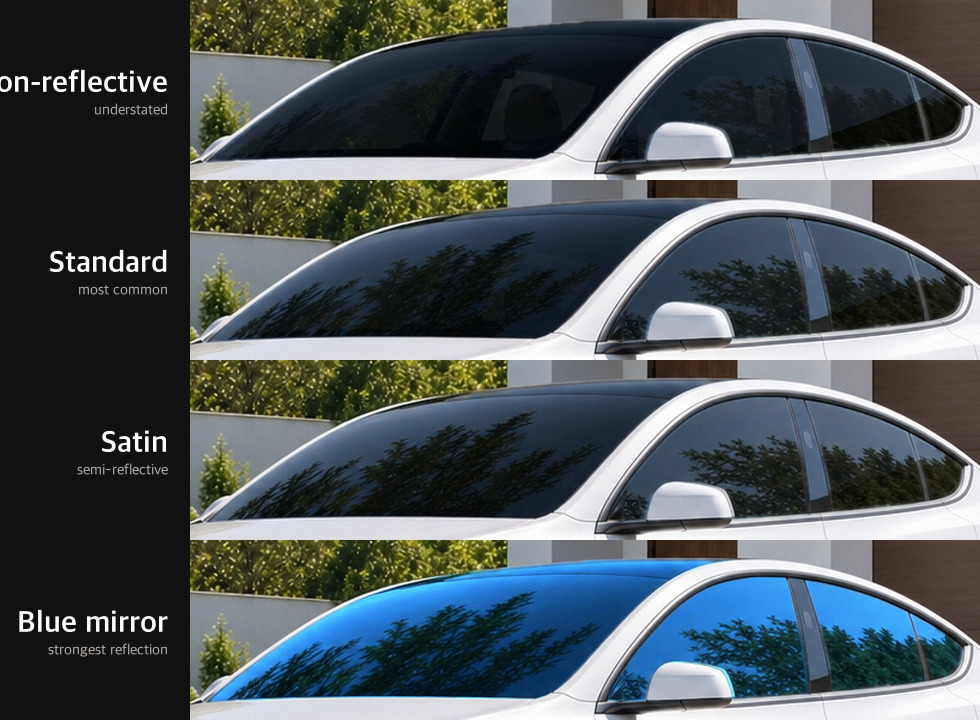
Reflectivity — how much the surface mirrors
How strongly the glass bounces back its surroundings. This is a separate axis from shade: the same dark 15% can read as flat and quiet, or as a bright mirror.
- Non-reflective — barely mirrors at all
- Standard — about what plain glass does
- Satin — a soft sheen
- Mirror — reflective from outside; the cabin all but disappears
Shade mostly controls whether the interior is hidden; reflectivity mostly controls how the car reads from outside. If your goal is privacy, lower the VLT first — reflectivity adds shine on top of that.
In the real market the two are coupled
This tool lets you set hue and reflectivity independently, because for comparing designs that freedom is more useful. The product market does not work that way.
Films that produce colour are usually sputtered with metal, and metal reflects. Films with almost no cast — carbon and ceramic — reflect little. So a "vivid green film that doesn't reflect at all" barely exists in practice.
If you land on a combination that pairs strong colour with low reflectivity, ask your installer whether a product exists that does both before committing.
Before choosing a metallic film
Highly reflective metallic films can attenuate radio signals. Toll transponders, GPS, key fobs and glass-mounted antennas may be affected.
- If you use a windscreen-mounted toll transponder, ask about signal interference.
- Installers often leave a non-metallic window for the device, or reposition it.
- Non-metallic films (carbon, ceramic) largely avoid the issue.
A workable order
- Shade first. How much you want hidden is the biggest decision.
- Then hue, against your paint colour. Bronze on white reads very differently from neutral on black.
- Reflectivity is taste. Satin and up to stand out; non-reflective to stay discreet.
- Find the product after you know the look — going product-first narrows you early.
The hues and reflections shown here are computed approximations and may differ from real products. We are still calibrating them against photographs of actual installations.
See it yourself — tint preview →
More guides
- How to use the tint preview
Four windows, three axes, two rows of presets. Three minutes to the picture you want — and what the screen cannot show.
- How to choose a tint shade (VLT)
What 70, 50, 40, 30, 15 and 5 percent actually look like — and why the same film looks different in every photo.
- Tint VLT comparison: 70% to 5%
What each level looks like from outside and from inside, in one table — and why the numbers differ between countries.
- Korean window tint law, explained
Where the 70% windshield and 40% front-side limits come from, how they are measured, and which windows are unregulated.
- Mirror tint: how it looks and whether it's legal
How reflective film works, what it actually looks like, and the legal points to check before you book.
- Before you book: a checklist
How to decide the per-window combination, and what to ask the installer.
- Tesla Model Y: window-by-window
Large glass area, an all-glass roof, heat-formed curves — what to watch for on a Model Y.