How to choose a tint shade (VLT)
The first number you meet when choosing tint is VLT — Visible Light Transmission. The higher the number, the more light passes through and the lighter the glass looks.
"70%" means 70% of light gets through, so it is nearly clear. "5%" lets only 5% through and is almost opaque. It reads backwards at first: darker tint means a smaller number.
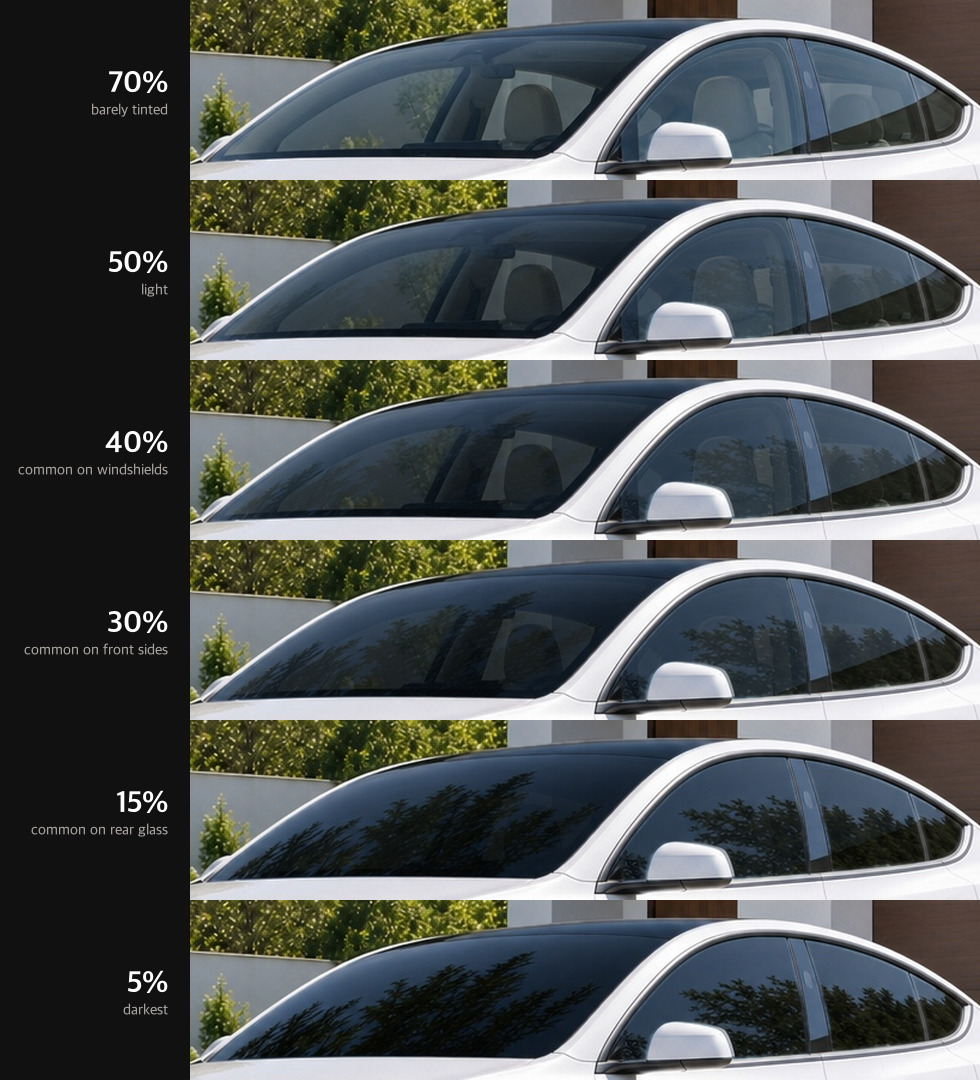
What each level looks like
| VLT | Impression | Commonly used on |
|---|---|---|
| 70% | Nearly invisible — you may not notice it is there | Windshield (to meet the Korean limit) |
| 50% | Light. The interior is clearly visible | Windshield |
| 40% | Gently dark. Interior visible but less conspicuous | Windshield |
| 30% | Silhouettes by day; interior visible at night | Front side windows |
| 15% | Hard to see in from outside; still fine looking out | Rear sides, rear glass |
| 5% | Darkest. Night rearward visibility drops noticeably | Rear sides, rear glass |
What people actually pick
We tallied 12 Korean installation reviews that listed the shade for each window (August 2026). It is a small sample, so treat it as a tendency rather than a rule — but two things stand out.
| Window | Most common | Next |
|---|---|---|
| Windshield | 40% (6) | 50% (5) |
| Front sides | 30% (9) | 15% (3) |
| Rear sides | 15% (8) | 30% (4) |
| Rear glass | 15% (6) | 30% (5) |
Only four values appeared at all — 15, 30, 40 and 50. Numbers often quoted in shops, like 35% or 25%, did not show up in this sample. And the pattern is consistent: lighter at the front, darker toward the back.
Check the legal limit for the windshield. In South Korea the Enforcement Decree of the Road Traffic Act, Article 28, sets the windshield standard at 70% VLT. The 40–50% seen above sits well below that. See Korean window tint law, explained. Limits differ by country and by US state.
Why the same percentage looks different in every photo
Search for "35% tint" and some photos look bright while others look black. Four things stack up.
- The glass already cuts light. Factory glass is not 100% either. The final figure is the glass and the film multiplied together, so the same film lands differently on different cars — especially where the rear glass is already privacy-tinted from the factory.
- A bright interior shows through. Light seats and a pale cabin read through the same film that a black interior would hide completely.
- Ambient light dominates. On a clear day outdoors the sky reflects off the glass and hides the cabin; in a parking garage the same film looks transparent.
- Photos are exposed differently. Shop photos are usually brightened, and your own screen brightness changes what you see.
So a number alone is a poor basis for the decision. You need the same car, the same angle and the same light, with only the shade changing. That is what this tool is for.
An order to decide in
- Start with the rear. Unregulated in Korea, and the privacy motive is clearest there.
- Front sides affect your mirror view while driving. If you drive at night often, go one step lighter.
- The windshield last. It affects vision most, and it is where the legal limit bites.
- Different shades per window show as a visible step from outside. Keeping neighbouring windows within a step or two of each other looks more natural.
See it yourself — tint preview →
More guides
- How to use the tint preview
Four windows, three axes, two rows of presets. Three minutes to the picture you want — and what the screen cannot show.
- Tint VLT comparison: 70% to 5%
What each level looks like from outside and from inside, in one table — and why the numbers differ between countries.
- Korean window tint law, explained
Where the 70% windshield and 40% front-side limits come from, how they are measured, and which windows are unregulated.
- Hue vs. reflectivity
Charcoal, neutral, green, blue, bronze — and why colour and mirror finish tend to arrive together.
- Mirror tint: how it looks and whether it's legal
How reflective film works, what it actually looks like, and the legal points to check before you book.
- Before you book: a checklist
How to decide the per-window combination, and what to ask the installer.
- Tesla Model Y: window-by-window
Large glass area, an all-glass roof, heat-formed curves — what to watch for on a Model Y.